

The History of Emperor Vikramarka
Another significant historical timeline is the Saka (Era) of Emperor Vikramarka. The legendary poet Kalidasa documented the emperor’s grand victories in the concluding chapters of his astrological treatise, the Jyotirvidabharana—a text that has been defended as an authentic historical work rather than a later fabrication.
The Court of Nine Gems and Great Scholars
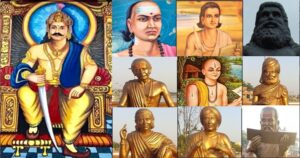 Emperor Vikramarka’s court was renowned for its unparalleled intellectual brilliance, celebrated even in the verses of ancient Jaina poets. His assembly featured an array of extraordinary scholars across diverse fields of science and the Sastras, including:
-
The Navaratnas (Nine Gems): The core group of illustrious scholars, which famously included the poet Kalidasa, the astronomer Varahamihira, and the lexicographer Amarasimha.
-
Eminent Scholars & Playwrights: Sri Sanku, Suvak, Vararuchi, Mani, Angudatta, Vishnu, Trilochana, Ghatakarpara, Satya, Srutasena, Badarayana, Maniththa, and Kumarasimha.
Demonstrating his deep reverence for knowledge and governance, the Emperor maintained a structured court that honored:
-
800 Subordinate rulers and chieftains.
-
16 Master Astrologers.
-
16 Eminent Doctors (Vaidyas).
-
16 Bhattas (scholars following the school of Kumarila Bhatta).
-
16 Vedic Scholars.
The Might of the Imperial Military
The sheer scale of Emperor Vikramarka’s dominion is reflected in the massive numbers of his imperial armed forces, which comprised:
-
3 Crores (30 million) total military personnel.
-
4 Lakhs (400,000) warships.
-
24,300 war elephants.
-
10,000 cavalry horses.
-
10,000 elite warriors on chariots.
Emperor Vikramarka established his own historical Saka (Era) in the Kaliyuga after defeating 99,999 Sakas. Renowned for his boundless charity and grand donations, he expanded his empire by conquering numerous prominent regions, including Dravida, Lata, Gandhara, Vanga, Gauda, Gujarat, Dhara, and Kambhoja.
Even the reputedly invincible mountain fortresses of the Himalayan kings fell to his military brilliance. Demonstrating his noble statesmanship, Vikramarka did not annex these territories; instead, he permitted the defeated kings to continue ruling their respective kingdoms as independent sovereigns.
Operating from his capital city of Ujjain, Vikramarka launched a successful northern expedition against Sakeswara, the Saka king who ruled Rukmadesa beyond the Himalayas. He captured the foreign ruler, brought him to Ujjain in a grand victory procession, and subsequently released him. The Mahakavi (Great Poet) explicitly notes that he composed his epic in the year 3068 of the Kali Era, marking the true inception of the Vikrama Samvat (the Vikramarka Era). Because of his decisive victories over foreign invaders, his glory endured, and the Vikrama Samvat remains widely in use across Northern India today.
The Historical Timeline Discrepancy
Western and modern mainstream historians later reinterpreted his legacy, asserting that his actual name was Chandragupta II and that “Vikramaditya” was merely his royal title. Through this framework, they shifted his timeline forward to 388–409 A.D. to align with his victories over the Western Sakas. This chronological shift effectively erases a vital period of roughly 400 years, causing a significant gap in the recorded history of the nation.