

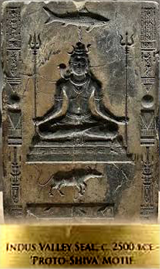
Excavations conducted in the villages surrounding Harappa and Mohenjo-daro (Bharat) have yielded emblems, seals, and artifacts associated with incarnations of Lord Shiva. These archaeological finds serve as evidence that the worship of Lord Shiva was prevalent over five thousand years ago, with Harappan relics exhibiting an antiquity tracing back up to 8,000 years.
The name Harappa incorporates the root word “Hara”, a 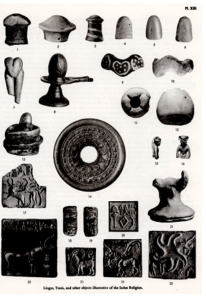 well-known synonym for Lord Shiva.
Derived from the verbal root “Hru” (Harane), the grammatical rule states:
“हरति प्रलये सर्वमिति हरः।”
(One who dissolves/destroys the entire universe at the time of cosmic dissolution is called Hara.)
A secondary meaning refers to the deity who removes or steals away the afflictions (klesha) of his devotees.
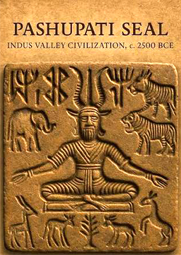 The famous Pashupati Seal discovered at Mohenjo-daro provides several visual cues that align directly with Vedic descriptions and classical Shaivite iconography:
Pashupati (Lord of Animals): Named Pashupati because the central figure is surrounded by animals (Amarakosha 1-30).
Ganga and Ardhanagra (Half-Moon): In the seal, a stream representing the river Ganges emerges from the top-center of Rudra’s head, alongside a crescent moon representation on the side.
Pranava (Omkara): To the right of the figure lies a symbol representing Ardha-Pranava (half Omkara), often misidentified as horns.
Headdress & Features: While some historians described the figure as three-headed, analysis suggests a single head without hair (Tarataraala Bharata Charitra, p. 21). This corresponds to Vedic references describing Rudra as Munda (bald/shaved) and Vyuptakesha (having close-cropped or shaved hair).
The symbols present on the seal and surrounding relics directly parallel epithets found in the Sri Rudram (Namakam), Taittiriya Aranyaka, Amara Kosa, and Shiva Purana:
| Feature / Symbol in Relics | Textual Term / Reference | Source | Significance |
| River / Water Element | Gangadhara | Amarakosha 1-54 | One who bears the Ganga on His head. |
| Ferocious Appearance | Bheema / Ugra | Amarakosha 1-35 / Sri Rudram | Terrifying or formidable form inspired by divine awe. |
| Elephant & Human Figures | Gajeswara / Nararshabha | Shiva Sahasranama (14, Sloka 8) | Lord of Elephants / Supreme among Men. |
| Omkara Symbolism | Taraya | Sri Rudram | Embodiment of the Pranava (Aum). |
| Armour Representation | Kavachine | Sri Rudram | One who wears protective armor. |
| Weapon / Arrow | Ayudhine / Isushmate | Krishna Yajurveda (4.5) | One who holds weapons/arrows. |
Several artifacts found across the Harappan sites reflect specific manifestations described in the Shatarudra Samhita of the Shiva Purana:
Vrishabhavatara & Nandiswara: Images and figurines of the sacred bull (Vrishabha) and Nandiswara are prominent throughout Harappan sites (Shatarudra Samhita, Ch. 6 & 23).
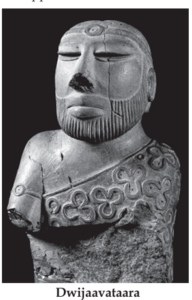
Dwija / Dwijeshwaravatara: Priest-like figures and busts depicting a deity wearing a garment draped over the left shoulder mimic the wearing of the Yajnopavita (sacred thread) as prescribed in the Taittiriya Aranyaka (Pra. 2).
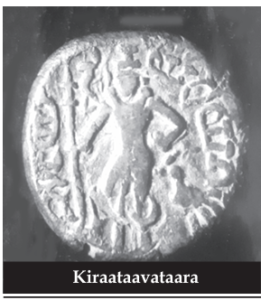
Kirateswaravatara: Relics depicting a hunter-like figure correlate to Shiva’s form as Kirata (the divine hunter) (Shatarudra Samhita, Ch. 37).
When analyzing the iconography, symbols, and artifacts of the Harappan culture alongside the Vedas, Shiva Purana, Sri Rudram (Namakam), and Shiva Sahasranama, there is a clear and systematic structural alignment. The evidence strongly demonstrates that early Shaivite traditions and iconography were integral to the civilization.